The Time Traveler's Phrasebook: Notes on Talking Across Generations
April 18, 2026 · 12 min read
Why does your Boomer parent not text back?
The reason has nothing to do with caring. They grew up in a world where a phone call meant someone was thinking about you, and a text feels, to them, like the minimum viable effort. To you, the text is the effort. You chose them out of the twenty-seven things competing for your attention. You composed a message. You pressed send.
Same action. Different dictionaries.
The pattern is always the same. Each generation assumes its communication style is the natural one, and everyone else’s is a deviation. Boomers think Millennials are fragile. Millennials think Boomers are rigid. Gen X is in the corner wondering why everyone is so loud. Gen Z is communicating in a meme format that renders the entire debate in 144 pixels.
Nobody is wrong. Everybody is translating from a language the other generation didn’t grow up speaking.
Why Generations Speak Different Languages
Each generation’s communication style was forged by the world they grew up in. Not chosen — forged. Like an accent, it’s the imprint of environment on expression.
What follows is Western, mostly American, with cohort years drawn from Pew Research Center. Generational lines form differently in other parts of the world, and that’s worth its own post. It’s still enough to get at the work underneath.
One caveat before the profiles, because it changes how to read them. Generation labels are a rough map, not the territory, and a lot of researchers would rather we folded the map entirely. A 2020 National Academies report on workforce management found the categories too crude to be scientifically useful, since any two people born in the same twenty-year span differ far more from each other than their cohorts do on average. Pew, whose cohort years I’m using, announced in 2023 that it would stop publishing routine generational comparisons unless the data could carry the weight. So read the profiles below as tendencies shaped by shared events and shared technology, not as personality types. The second half of this post is about what actually varies underneath them.
The Silent Generation and WWII Generation (born before 1945) grew up during depression and global war. Communication was stoic by necessity. You didn’t burden others with your feelings because everyone was already burdened. Emotional restraint wasn’t repression; it was contribution. Keeping it together was how you served your family and community. Their communication style: measured, formal, action-oriented. Show love through sacrifice, not words.
Baby Boomers (1946-1964) grew up in unprecedented prosperity and cultural upheaval. They invented the generation gap. Literally, they were the first cohort to define themselves in opposition to their parents. Their communication style was shaped by town halls, office hierarchies, and the telephone. They value face-to-face or voice-to-voice conversation, interpret formality as respect, and tend to separate personal and professional communication styles. A Boomer’s idea of connection is a long phone call. A text message can feel impersonal, even dismissive.
Generation X (1965-1980), the latchkey generation, grew up with working parents, rising divorce rates, and a media landscape that taught them to be skeptical of institutions and self-reliant in problem-solving. Their communication style is direct, informal, and efficient. They email. They get to the point. They are suspicious of both Boomer formality and Millennial emotionality, and they often serve as the unofficial translators in multigenerational workplaces.
Millennials (1981-1996) are the first generation to grow up with the internet from adolescence. Their communication is collaborative, feedback-oriented, and values-driven. They text more than call. They expect transparency from institutions and leaders. They’re comfortable discussing emotions in professional contexts, which reads as “oversharing” to Boomers and Gen X, and as “basic” to Gen Z.
Generation Z (born 1997-2012) is the first generation to grow up fully inside the smartphone era. Their communication is visual, rapid, layered with irony, and often asynchronous. They communicate in memes, short-form video, and voice messages. They’re remarkably open about mental health, not because they’re fragile, but because they grew up in a culture that normalized the conversation. Their directness about emotional states can feel jarring to older generations who learned to keep those conversations private.
The Translation Challenge
The friction is about context, not character.
When your Gen Z daughter sends a meme instead of answering your question, she’s not being dismissive. The meme is the answer. It contains emotional nuance, cultural reference, and humor in a format that communicates more efficiently, in her language, than a paragraph of text.
When your Boomer father calls you on the phone instead of texting back, he’s not ignoring your preferred communication channel. He’s upgrading the conversation — in his language — to a higher level of personal investment.
Gen Z to Boomer: Sends a TikTok of someone looking exhausted with the caption “me after work”
What they mean: “I had a terrible day and I need you to know that, but I’m processing it with humor because that’s how I cope.”
What Boomer hears: “Why are you sending me a stranger’s video instead of telling me about your day?”
Boomer to Millennial: “Let’s not discuss personal issues at work. Keep it professional.”
What they mean: “I was taught that separating personal and professional is how you show respect for both.”
What Millennial hears: “Your feelings don’t matter here. Perform productivity and suppress everything else.”
Neither party intends the message the other receives. They’re both communicating in good faith, just in different languages.
Habits, Not Buckets
Here’s what the map is missing. Generation labels aren’t what actually varies between people. What varies is a set of communication habits, and those habits differ between siblings, between coworkers, between people born the same year.
Linguist Gretchen McCulloch makes a parallel argument about digital communication in Because Internet (2019): when and how you came online shapes your digital dialect more than when you were born. Two 55-year-olds can write very differently if one’s been online since 1995 and the other joined Facebook in 2015.
The habits fall along a few axes. You can locate yourself on each one:
- Formality. Measured and ceremonial at one end, casual and stripped-down at the other. Do full sentences in a text message read as respect or as stiffness?
- Emotional disclosure. Private and contained at one end, open and named at the other. When you ask “how are you?”, is that a real question or a ritual?
- Channel. Voice and face-to-face at one end, text in the middle, visual and meme-layered at the other. When you need to say something important, what do you reach for?
- Pace. Synchronous and immediate at one end, asynchronous and considered at the other. Is a two-day reply thoughtful or dismissive?
- Directness. Explicit at one end, implied at the other. Do you ask for what you want, or signal it and let the other person pick it up?
Plotted across generations, the axes look like this:
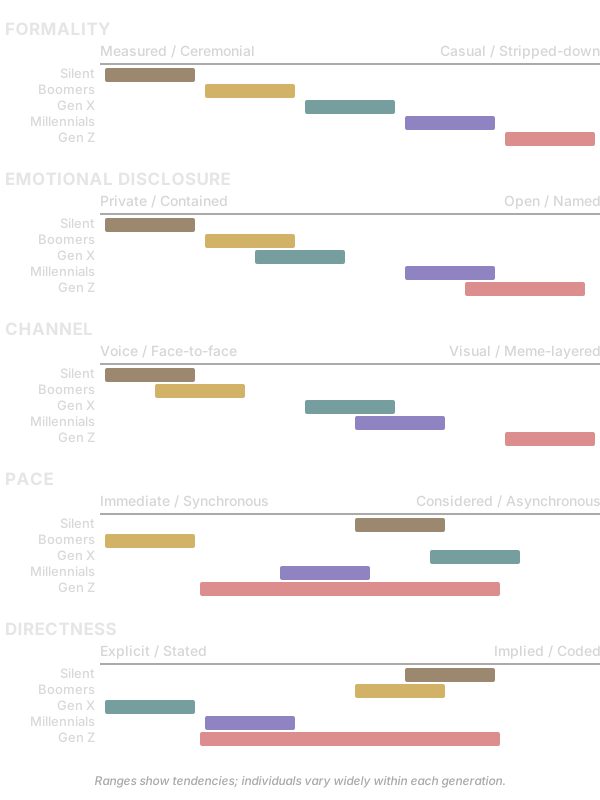
Three of those axes run in a straight line from Silent to Gen Z. Two don’t. Which is the point.
Most people don’t sit neatly inside their generation’s defaults on every axis. Consider the cuspers. Xennials remember when one landline served the whole house and you always answered. No caller ID, no voicemail. A missed call was a message you’d never hear. Then they entered a workforce that demanded tech-fluency overnight. Zillennials, born at the Gen Y/Z seam, T9-typed on flip phones and came of age as Instagram eclipsed Facebook, code-switching between Millennial earnestness and Gen Z irony without blinking. Walking proof that habits travel. Some Millennials were raised by Silent Generation grandparents and inherited that formality. Some Boomers went back to school at 49 and fell in love with texting their grandkids memes.
Some people do cross-generational communication well. Not because they were born on a boundary. Because they chose to learn a second dictionary. They noticed their defaults weren’t the only options, and they got curious.
So the more useful question isn’t “what generation is this person?” It’s this: which axes do you lean on hardest? And which axes does the person you struggle with most lean on hardest?
That gap, not the birth year, is the thing to translate.
Translate, Don’t Mimic
Understanding someone’s dictionary doesn’t mean writing in their handwriting. If you’re a Gen Z native, you don’t need to sign off voicemails like a radio host to reach your grandfather. If you’re a Boomer, you don’t need to learn meme-Morse to text your grandchild. Style-matching is obvious, and it tends to fall somewhere between condescension and parody.
The move is smaller than that. Stay yourself. Then pick the version of what you want to say that has the best chance of being heard.
- Same message, different medium. A hard thing said on a phone call to your Boomer parent carries weight that the same words on a text don’t. A thought sent as a voice memo to your Gen Z nephew carries warmth that a paragraph doesn’t.
- Same meaning, different pace. Your Gen X sibling who takes a day to reply to the family group chat isn’t distant; that’s their cadence. Your Boomer parent who gets worried when you haven’t texted back in a few hours isn’t smothering; in the world they grew up in, unreachable meant something was wrong.
- Same intent, different packaging. A handwritten “I’m proud of you” carries something for a Silent Generation grandparent that a text never will. A funny meme captioned “you” carries the same affection for a Gen Z kid that a formal compliment can’t. Pick the wrapping that reads as care to them, not the one that reads as care to you.
You don’t have to do this every time. Adapting your delivery is a tool for when a point needs to be heard, not a tax on every exchange. Sometimes the move isn’t to change how you communicate. It’s to tell the other person how you communicate. “I’m slow on texts, it’s not personal” saves a lot of silent misreading. Naming your own habits is a form of translation too.
Bridging the Gap: Practical Strategies
In Families
Ask about formative experiences, outside the argument. Mid-conflict, these questions read as deflection. In the slow moments, over coffee or on a walk, they read as genuine care. “What was it like calling someone on a rotary phone?” or “What did your parents do when you were upset?” Real interest in the infrastructure behind someone’s communication style builds real empathy.
Translate, don’t judge. When your parent’s advice sounds patronizing, try hearing it as concern expressed in the only format they know. When your kid’s response seems dismissive, try seeing it as efficiency rather than disrespect.
Find overlapping channels. Most families have at least one communication mode that works across generations. For some it’s the family group text. For others it’s the Sunday phone call. For many it’s food — cooking together, eating together, sending recipes. Find the channel where everyone feels comfortable and invest in it.
In Workplaces
Make norms explicit. The biggest source of generational friction in workplaces is unspoken norms, not values. Does a meeting require cameras on or off? Is Slack for urgent messages or casual conversation? Should feedback be delivered publicly or privately? Making norms explicit removes the guesswork that leads to misinterpretation.
Leverage generational strengths. Boomers bring institutional knowledge and relationship depth. Gen X brings pragmatism and independence. Millennials bring collaborative instinct and values alignment. Gen Z brings digital fluency and adaptability. These are tendencies shaped by experience, not stereotypes, and they complement each other beautifully when recognized rather than dismissed.
Mentor in both directions. The assumption that mentorship flows from old to young is itself a generational artifact. Reverse mentoring, where younger employees mentor older ones on technology, culture, or communication trends, is a fixture of corporate training programs, and workforce researcher Jeanne Meister made the case for it in The 2020 Workplace (2010). You don’t need a program to use the idea. The real benefit isn’t the skill transfer anyway. It’s the mutual respect built by taking turns being the one who doesn’t know.
The Deeper Pattern
Generational tension is really a specific case of a universal pattern: people who go through different experiences develop different communication defaults, and then assume their own defaults are universal.
It’s the same dynamic between cultures, between regions, between professional fields. A surgeon and a social worker will miscommunicate not because one is smarter, but because they’ve been trained in radically different communication environments.
The cure is the same in every case. You don’t have to ask anyone about their childhood. You don’t have to conduct an interview. You just have to stop assuming that the words they used mean what those words would have meant coming from you.
Listen for the meaning under the words. That’s the whole practice.
A question worth carrying around for a week: what about your upbringing set you apart from your generation’s defaults? Where do your habits line up with your birth year, and where did you break from it?
Every generation is doing its best with the tools its world provided. The question isn’t who has the right tools. The question is whether we can learn to use each other’s.
Your parents are not outdated. Your children are not broken. Everyone in the room is a translator, working with an incomplete dictionary and the best intentions they can muster.
The people who do this well aren’t the ones with the best guesses about what era shaped someone. They’re the ones who stopped assuming their own dictionary was the right one. You may know one of them. You may even be one yourself. Either way, the practice is the same.
Meet others where they are. That’s how your dictionary grows.
Speak kindly. Listen closely. Paws often.
— Pax
Thanks for reading. If you'd like Pax delivered to your inbox, subscribe on Substack — new posts arrive there a day or two after they appear here.
Related Reading
- Beyond Love Languages: The Science of Actually Hearing Each Other — The science of empathic listening across any divide, not just generational.
- Surviving the Holiday Table: A Field Guide to Difficult Family Conversations — Where generational divides meet holiday dinner tables.
- The Human in the Machine: Making AI Serve Connection, Not Replace It — The technology gap is one of the biggest generational divides of all.