Comparison
Naming your feelings to a child, by age

August 3, 2026 · 4 min read
“You hurt my feelings” reaches a nine-year-old. It doesn’t reach a three-year-old, and the difference isn’t vocabulary. It’s what a child’s mind can do with the claim that you have an inside.
Five capacities arrive over roughly a decade, each one changing what the sentence can carry. They arrive gradually, they overlap, and no child crosses on schedule.
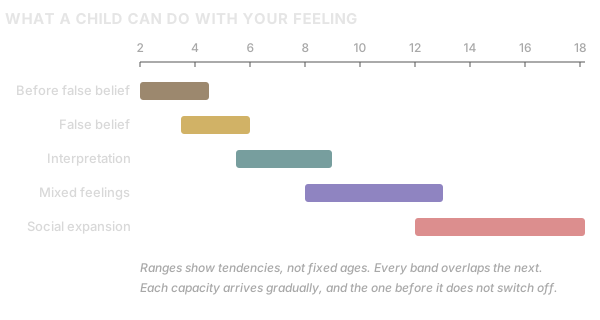
Before false belief (up to about four): your feeling isn’t information yet
Below the false-belief threshold, a child works from the assumption that everyone’s inner world matches their own. Henry Wellman and colleagues placed that threshold near age four in a 2001 Child Development meta-analysis, and what sits below it is not indifference. The child’s equipment for treating your feeling as a separate fact about a separate person hasn’t finished assembling.
So the abstract version doesn’t reach. Name the act and the feeling together instead: when you hit, I felt sad. That pairing is concrete enough to hold onto, even before the wider idea of causing someone a feeling is available.
Specificity is also the protection, which is the part most parents aren’t told. A feeling with no act attached gives a young child nothing to pin it to except themselves. Hitting made my parent sad is a manageable thing to carry at four; I make my parent sad is not. Naming the act keeps the claim the right size.
False belief (about four to five): other minds become other
False-belief understanding consolidates, and other people stop being extensions of the child’s own perspective. A child this age can register that someone else believes something untrue, knows something they don’t, feels something they aren’t feeling.
This is where your feeling becomes receivable as news rather than noise. Keep the event attached to it. A four-year-old can hold that you felt sad; they still need to know which moment you mean.
Interpretation (about six to eight): the same event, read two ways
Two things arrive close together here. First a child can track beliefs about beliefs, the structure Josef Perner worked through in Understanding the Representing Mind. Then comes something more useful to you: Jeremy Carpendale and Michael Chandler, in a 1996 study in Child Development, showed children moving past false belief into an interpretive theory of mind. Two people can take in the identical event and come away with legitimately different readings of it, without either of them being wrong or lying.
That capacity is what lets a child receive I know you didn’t mean it, and it still hurt as one coherent sentence rather than a contradiction. It’s also the developmental substrate for the gap between intent and impact.
Mixed feelings (about nine to twelve): two feelings about one person
Susan Harter and Bonnie Buddin mapped a five-stage sequence for this in Developmental Psychology in 1987, working with children from four to twelve. The late stages are the ones that matter here: holding two opposite feelings, aimed at the same person, at the same time. Jeff Larsen, Yen To and Gary Fireman confirmed the age gradient in Psychological Science in 2007 and extended it: older children don’t just understand mixed emotions, they’re more likely to actually feel them.
This is the quiet reason the conversation gets easier as children get older. A child who can hold my parent is hurt alongside my parent loves me has somewhere to put the first one. Younger than that the two don’t sit together as readily, and an unanchored “you hurt me” can compress into “I am bad.” That isn’t an argument for staying silent at four. It’s the argument for the small, specific sentence at four, which is the same protection described in the first band, arriving here as the reason it was needed.
Social expansion (adolescence): the audience widens
The capacity is fully available by now, and a bored or scornful response is not evidence otherwise. Laurence Steinberg’s work on the adolescent brain describes a stretch of unusual plasticity, which is why this is one of the most responsive periods for a relationship to shift rather than one of the least. A teenager knows exactly that you have an inside. Armoring up around them removes the only thing that was working. The Bridge Years covers what changes about the rest of the conversation.
What doesn’t change
The phrasing moves across all five bands. The shape doesn’t. Name the specific thing, say that it hurt rather than how much, and close the loop yourself instead of leaving a silence for the child to fill. What varies is how much abstraction the sentence can carry, not whether the sentence is fair to say.
The line it must not cross holds at every age too. Say the true thing and then let go of it, rather than holding it out until something comes back.
Related: When You Should Tell Your Child They Hurt You
From the essay: Read the full piece →
Want more like this? Subscribe to the newsletter.