Red Flags You're Missing: 7 Signs a Conversation Is About to Go Off the Rails

October 16, 2026 · 8 min read
Have you ever left a conversation thinking, “How did that go so wrong so fast?”
It probably didn’t go wrong as fast as it felt. Most arguments build slowly, with warning signs you didn’t notice, or noticed but didn’t act on. Escalation tends to follow a pattern, and you can learn to read it.
Spotting the warning signs won’t prevent every conflict, but it means you can step in early, while it’s still cheap to fix.
Here are seven signs that a conversation is about to leave the rails, at home, with friends, or at work, and what to do about each one. The seven: a tone shift, absolutes, “yeah, but,” pulling away, playing to an audience, dragging up old fights, and a too-quick “fine.” If you just want the lines to say, they’re on a quick-reference card at the end.
Sign 1: The Tone Shift You Feel Before You Hear
This is the earliest warning, and it’s in how people sound and move, not in what they say. Something changes in the air. A jaw tightens. Shoulders rise. The rhythm of speech shifts, slightly faster or unnaturally slower. You might not be able to name what changed, but your body registers it before your conscious mind catches up.
Researcher Stephen Porges has a theory about this: your body is reading the other person’s face, voice, and movements the whole time, quietly checking whether you’re safe, without you having to think about it.
What to do: Trust the signal. When something feels off, stop arguing the point for a moment and check on the two of you. “Hey — are we okay? Something feels different.” It can feel exposed to say. Say it anyway. Caught this early, an argument often calms down before any of the other signs show up.
Sign 2: Loaded Language — “Always,” “Never,” “Every Time”
When absolutes enter a conversation, nuance is leaving. “You always do this.” “You never listen.” “Every time I try to talk to you…” Words like these turn one moment into a verdict on who the person is.
The person using absolutes usually doesn’t mean them literally. What they mean is “this pattern frustrates me.” But absolute words tend to put the listener on the defensive, and they start hunting for counterexamples. The listener brings up the time they did listen, the speaker defends the “always,” and now the argument is about how often it happens instead of how it feels.
What to do: Gently translate the absolute back into a specific. “When you say ‘always,’ I think you mean this keeps happening and it bothers you. Is that right?”
Sign 3: The “Yeah, But” Pattern
“Yeah, but” is the verbal equivalent of a closed door. One person offers a suggestion, an observation, or an olive branch. The other responds with “Yeah, but…”, which translates to “I heard you and I’m rejecting what you said without considering it.”
Count them. One “yeah, but” might be genuine disagreement. Three in a row usually means the person saying it has stopped listening. They’re reloading. It comes from defensiveness more often than malice, but it kills dialogue as effectively as any insult.
Negotiation expert William Ury noticed that people will sometimes turn down an idea just because it came from the other person. In his book Getting Past No, he suggests a simple swap: instead of saying “but,” say “yes” to what you can agree with, then add your view with “and.” Hearing “yes” first tells them you took their idea seriously before you add yours.
What to do: Name the pattern without blame. “I notice we keep saying ‘yeah, but’ to each other. What if we tried ‘yes, and’ for the next few minutes, just to see what happens?”
Sign 4: Body Language Withdrawal
Crossed arms. Turned shoulders. Broken eye contact. Leaning back. Phone-checking. Unlike the quick flash of tension in sign 1, these stick around. They’re the signs of someone leaving the conversation emotionally while staying in the room.
Not all crossed arms mean defensiveness (sometimes it’s just comfortable). But when body language changes during a conversation, especially after a charged exchange, it’s usually meaningful. The person is protecting themselves. The openness they started with has been replaced by armor.
What to do: Make space, not demands. “I can see this is hitting a nerve. Do you want to take a break, or would it help to talk about what just happened?” Pushing someone who’s pulling away to keep talking often makes them pull away more.
Sign 5: The Appeal to Audience
This sign shows up in group conversations, and it’s a strong hint that things are about to heat up. Instead of talking to you, the person starts talking about you to others present. “Can you believe this?” “Am I the only one who thinks this is ridiculous?” “Tell them what you told me.”
The appeal to audience serves two purposes: it recruits allies and it turns a private disagreement into a public performance. Once there’s an audience, whoever backs down loses face in front of people. Neither of you wants to be that person, so the conversation stops being about solving anything. It’s about winning.
What to do: Take it back to just the two of you. “I’d rather work this out between us. Can we step aside and talk one-on-one?”
Sign 6: Dragging Up Old Fights
You’re deciding who’s cooking dinner on Thursday, and suddenly it’s about the birthday you forgot in 2019. A jump to old grievances usually means resentment has been building for a while, and the dinner argument is just where it finally spills out.
Family therapist Terry Real has a name for going on the attack because you feel like the one who was wronged: “offending from the victim position.” The person bringing up 2019 feels hurt, so hitting back feels fair to them, whether or not it is. The old hurt may well be real. But using it as a weapon in an unrelated conversation doesn’t heal the old wound. It opens new ones.
What to do: Acknowledge the history without letting it hijack the present. “I hear you — that birthday still hurts, and I want to talk about it. But can we finish this conversation first and come back to that?”
Sign 7: The Too-Quick “Fine”
This one usually comes last, and it looks like compliance. The person suddenly gets very quiet. They agree too quickly. “Fine.” “Whatever you want.” “I don’t care.” They’re agreeing with you in words while everything else about them says the argument isn’t over.
What’s actually happening is a preview of stonewalling: shutting down and going quiet in the middle of a conflict. Psychologist John Gottman, who studies how couples fight, says stonewalling comes from feeling “flooded,” his word for being so stressed that your body takes over and you can’t think straight. That can happen to anyone in a heated argument, and someone who’s flooded may not be able to talk calmly right now, even if they want to.
What to do: Don’t accept the false peace. “When you say ‘fine,’ I don’t think you mean it. I’d rather hear what you’re actually feeling, even if it’s hard.” And if they can’t put it into words yet: “We don’t have to solve this now. Let’s come back to it when we’ve both had some space.”
Reading the Pattern
These seven signs often show up together, and one can set off the next. A tone shift can lead to loaded language. Loaded language can trigger “yeah, but.” The signs don’t always come in this order, and not every argument hits all seven (the appeal to audience needs other people in the room). But left alone, an argument tends to get worse, not better, and it usually ends at old grievances or the silent treatment, where the conversation stalls.
The good news: interrupting the pattern at any point can change where it’s heading. A tone check at sign one costs almost nothing. Repairing after sign seven usually means a real break first and a second conversation later, sometimes the next day.
Your Quick-Reference Card
For the next difficult conversation, keep these in your back pocket.
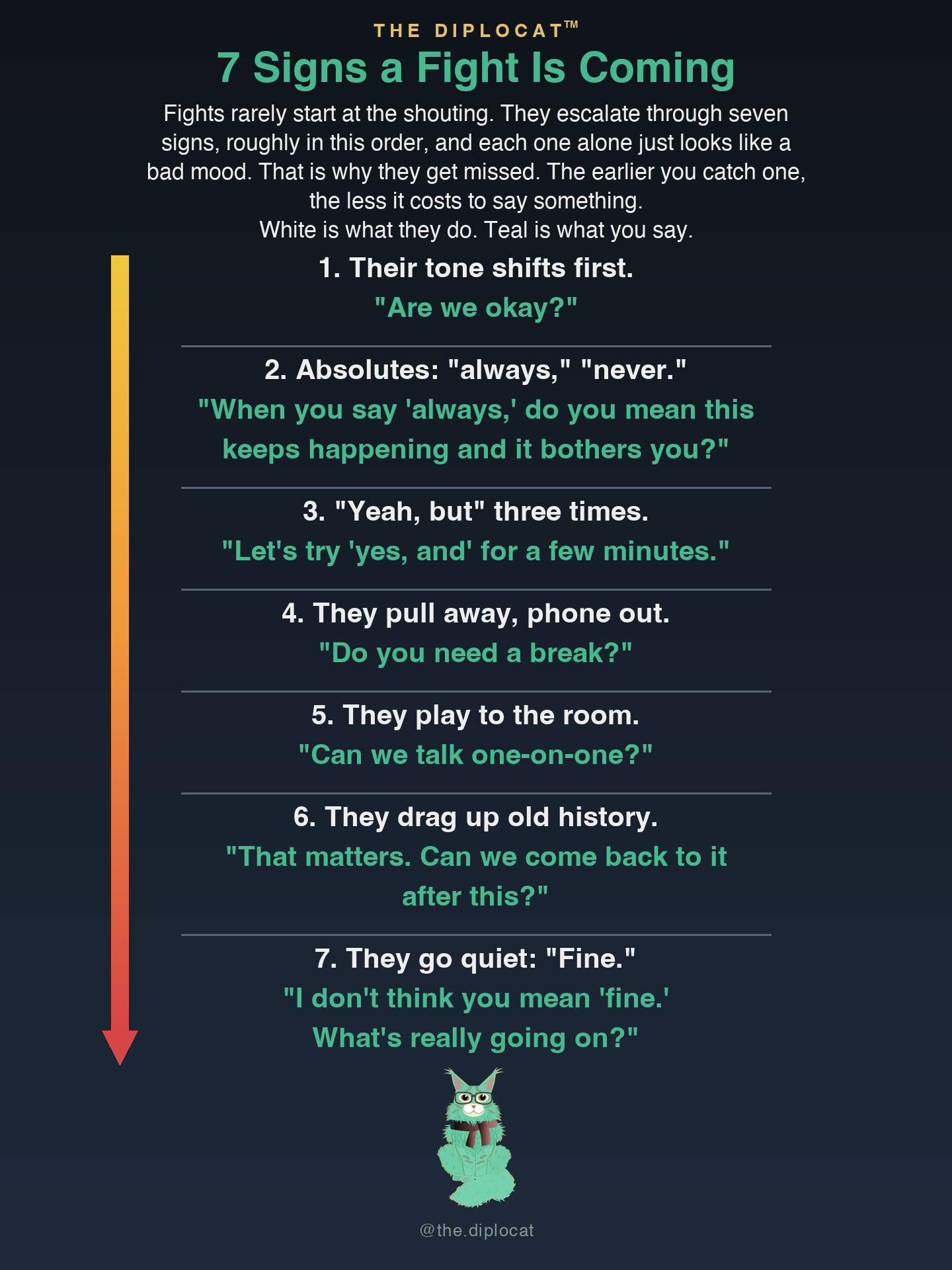
Text version
- Tone shift → “Are we okay?”
- Absolutes → “When you say ‘always,’ do you mean this keeps happening and it bothers you?”
- “Yeah, but” → “Let’s try ‘yes, and’ for a few minutes.”
- Withdrawal → “Do you need a break?”
- Audience appeal → “Can we talk one-on-one?”
- Old fights → “That matters. Can we come back to it after this?”
- Too-quick “fine” → “I don’t think you mean ‘fine.’ What’s really going on?”
Nothing on that card takes a therapist’s training, and you don’t have to use the exact words. Say it the way you’d normally talk. What matters is noticing what’s happening while it’s still small, and saying something about it before you answer the next point.
So the next time you walk away from a conversation wondering how it went wrong so fast, play it back. One of these seven was probably there, earlier than you thought, and spotting it in the replay is how you start spotting it live.
Speak kindly. Listen closely. Paws often.
— Pax
Thanks for reading. If you'd like Pax delivered to your inbox, subscribe on Substack — new posts arrive there a day or two after they appear here.
Related Reading
- Defusing the Bomb: De-Escalation Techniques from Hostage Negotiators to Kitchen Tables — What to do after you spot the red flags.
- The Communication Reset: A Single Habit That Will Transform Your Relationships This Year — The simplest intervention when you feel a conversation shifting.
- The Words We Choose: Why Language Is the First Step Toward Understanding — The word categories that most often trigger escalation.